One of the most important changes in Turkey's energy system over the last two years is that the pace of renewable capacity growth has made grid operation more data-intensive. According to official data, as of January 2026 there are 41,152 electricity generation facilities in the country, of which 39,084 are solar plants. Solar's share of installed capacity has reached 20.9% and wind's 12.1%. At this scale, distributed generation requires more intensive forecasting, balancing and flexibility management than the classic central generation structure.
The Ministry's 2026 announcements support this need. On one hand, 2,000–3,000 MW of new storage capacity is expected to activate; on the other, strengthening interconnector capacity with Europe and neighbouring countries is targeted. There is also roughly $30 billion in planned transmission investment by 2035. Read together, these developments show the energy system is not only growing larger but also more complex. In such a structure, AI-based demand forecasting, generation forecasting, fault prediction, market analytics and grid optimisation become increasingly critical.
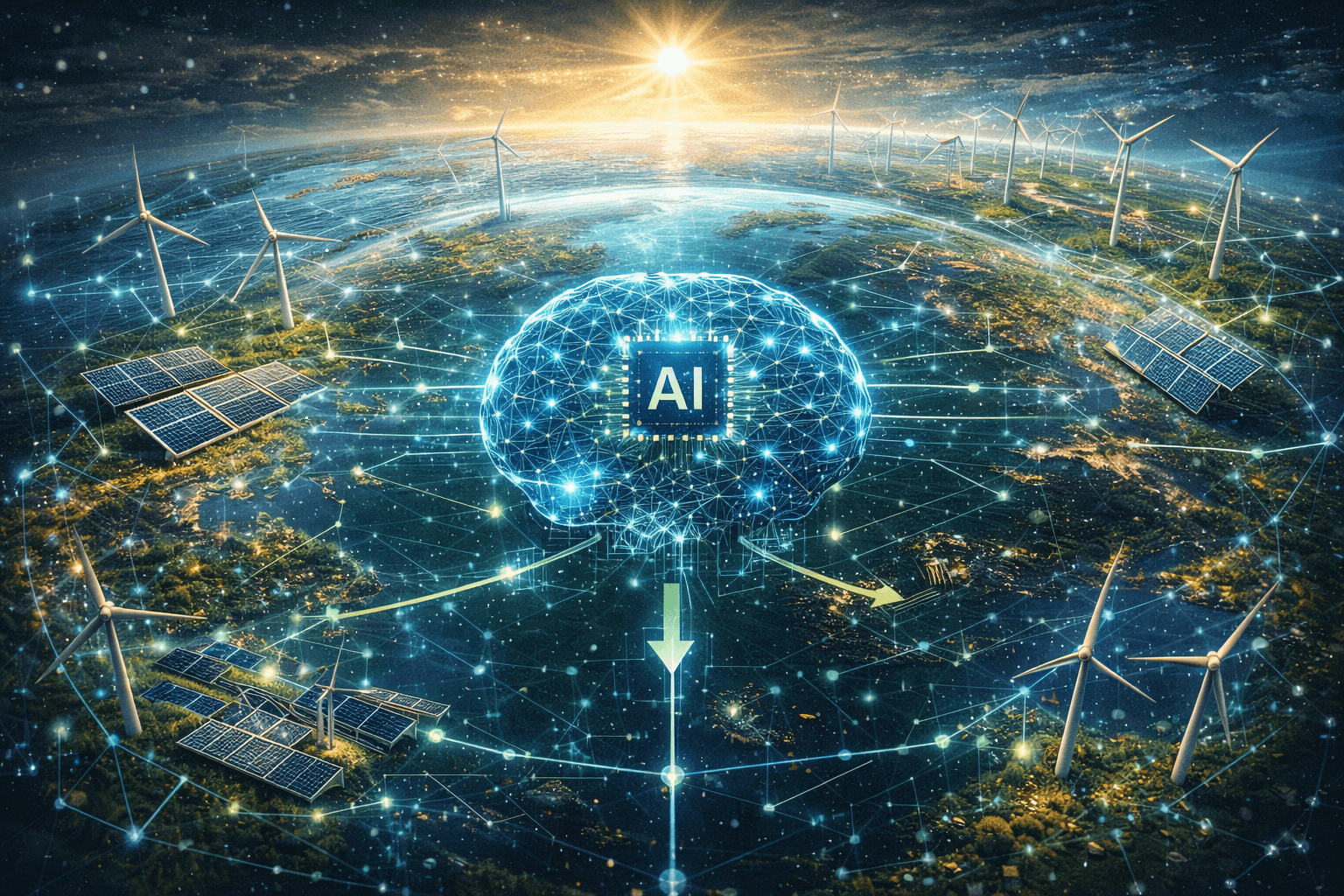
Traces of this digital backbone are clearly visible in Turkey's official documents. The Energy Efficiency 2030 Strategy foresees the spread of energy monitoring systems in industry, support for applications that strengthen data analytics, incentives for software work and the rollout of smart meters from 2026. The document also directly emphasises low-carbon, green and digital transformation. This suggests the "AI brain" metaphor in the image represents not a single government programme but the combined direction of official policy sets.
There are similar signals on the institutional side. The profile of EPİAŞ's Chief Information Officer appointed in 2025 highlights deep expertise in microservices and cloud architectures, data governance, cybersecurity and AI applications. This alone does not mean "EPİAŞ built an AI-powered national grid system"; but it indicates that digital transformation and advanced analytics capacity have become institutional priorities in energy market operation.
So the news framework for this image is: as Turkey approaches the third phase of its energy transition, physical capacity growth and the digital intelligence layer are growing together. As solar and wind's share rises, the coordination of timing, load management, storage dispatch, market forecasting and cross-border energy flows on the grid will require more algorithmic support. Official documents today define this in terms of smart meters, data analytics, energy monitoring and digital transformation; tomorrow's news language will likely call it an "AI-enabled energy system".