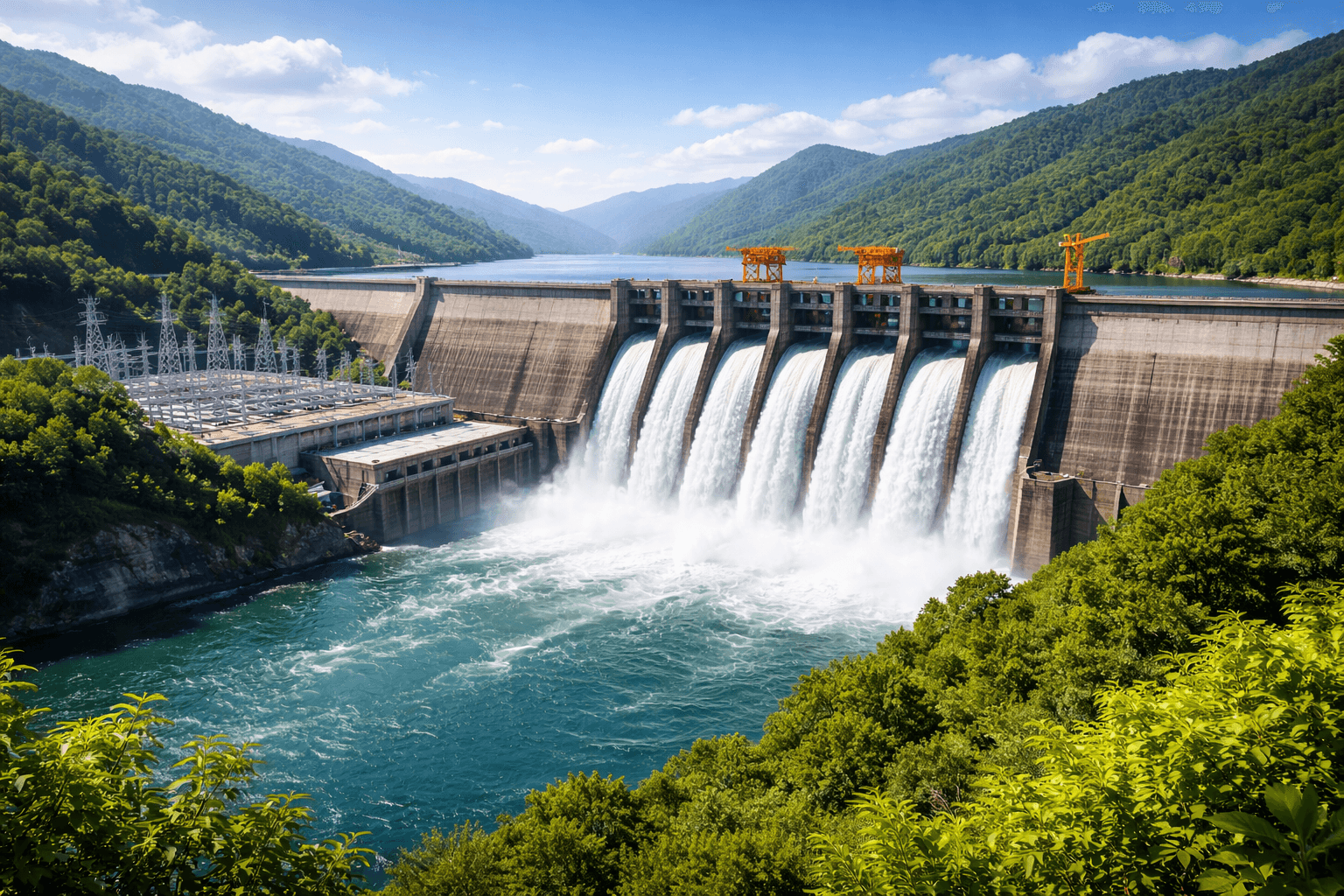
Hydropower has long been one of the most important components of Turkey's electricity system. With extensive river basins and mountainous terrain, the country has developed significant hydroelectric capacity over several decades.
Large hydroelectric dams along major river systems have historically provided a reliable source of electricity and helped support national energy security. Hydropower remains one of the largest renewable electricity sources in Turkey's generation mix.
Technology categories — Hydropower technologies can be classified into several categories. The most common type is reservoir-based hydropower, where large dams store water and release it through turbines to generate electricity. These facilities can also support irrigation, flood control, and water management.
Another important category is run-of-river hydropower, which generates electricity from the natural flow of rivers without large reservoirs. These installations typically have lower environmental impacts but produce less controllable output.
Pumped-storage hydropower is increasingly recognized as a critical technology for balancing renewable electricity systems. These systems store energy by pumping water uphill during periods of low electricity demand and releasing it to generate power when demand rises. As solar and wind capacity increase, pumped storage can provide valuable grid flexibility by acting as a large-scale energy storage solution.
Smaller hydro projects, often referred to as small hydro, are also common in mountainous regions where rivers provide suitable flow conditions.
Globally, hydropower remains the largest renewable electricity source, providing roughly one-sixth of the world's electricity generation. In Turkey, hydropower continues to serve as a key balancing resource that complements intermittent renewable sources such as wind and solar.
As the energy transition progresses, hydropower's role is expected to evolve toward supporting grid stability and energy storage rather than simply providing base-load generation.